 Derek Wang
The shift underway
AI applications are quietly re-architecting themselves three times at once - and most agent tooling was only built for the version before the shift.
The first generation of agent frameworks assumed a single model behind a single prompt. Then came multi-agent systems: a planner, a critic, a handful of specialists - each good at one thing, coordinating on a shared problem. Now a third shift is underway, and it’s the one infrastructure hasn’t caught up to: those agents are leaving the process. A planner and its workers used to share memory inside one Python process. Increasingly, they’re separate deployments, written in different languages, scaled independently, talking over the network.
That’s not a framework problem anymore. It’s a Kubernetes problem - the same one that service meshes solved for microservices a decade ago, except for a workload shape nobody designed Istio or Linkerd around: agents that hold a connection open for forty seconds waiting on an LLM, that need to find each other by role instead of by hostname, and that speak a protocol - A2A.
Every team re-solves the same problems
Pull apart a handful of production multi-agent deployments and the same scar tissue shows up in each one - usually written by whoever drew the short straw on “can you also figure out the Kubernetes side”:
- Wiring is hand-rolled. Agent A finds Agent B through an environment variable, a config map someone edits by hand, or a URL copy-pasted between YAML files. It works until an agent is renamed or a namespace changes.
- Autoscaling measures the wrong thing. Kubernetes HPA works best with CPU as the metric. An agent spends most of its time blocked on an LLM call or a tool invocation - CPU idle, concurrency slot fully occupied. HPA sees a quiet replica and does nothing while requests queue behind it.
- Rollouts drop traffic. A plain
kubectl rolloutdoesn’t know an agent is mid-conversation with a caller; a naive deploy can sever a long-running A2A exchange outright. - The protocol has no runtime. A2A is a wire format, not a platform. Making it actually work across languages and frameworks is left as an exercise for every team that adopts it.
- Nothing protects the downstream. One popular agent can be fanned out to by a dozen callers at once with no shared ceiling - and the LLM API or database behind it has no idea that’s about to happen.
None of this is agent logic. It’s plumbing - and every team is laying the same pipe, slightly differently, slightly worse, every time.
What Kynomesh is
Kynomesh is a Kubernetes-native control plane built for this exact shape of workload. The core idea is small on purpose: declare the agents that make up your system, how they’re allowed to reach each other, and which one takes the first call. Kynomesh turns that declaration into a running, self-healing fleet - each agent in its own dedicated pods, discoverable by name, talking A2A, scaled to the load it’s actually under.
Everything downstream of that declaration - placement, peer discovery, scaling, safe rollouts - is the platform’s job, not yours. Agent code stays agent code: plain A2A servers and clients, written against the official SDKs, in whatever language the task actually calls for.
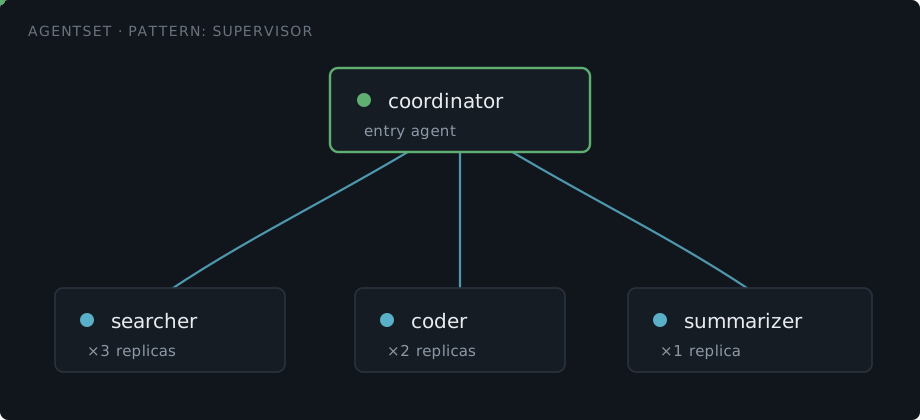
Here’s the whole declaration for a small research assistant - one coordinator delegating to a search agent, plus a third-party fraud-check agent it can call out to:
apiVersion: kynomesh.kyno.sh/v1alpha1
kind: AgentSet
metadata:
  name: research-assistant
spec:
  pattern: Supervisor
  entry: coordinator
  agents:
    - name: coordinator
      container:
        image: my-coordinator:latest
    - name: searcher
      container:
        image: my-searcher:latest
  externalAgents:
    - name: fraud-check
      url: https://fraud-check.example.com
That’s it. One of these agents may run in Go, another in Python; fraud-check isn’t deployed by Kynomesh at all - it’s just a URL, treated as a first-class peer anyway. None of that shows up as extra ceremony in the YAML above.
A small vocabulary for how a team talks
Most multi-agent systems collapse into one of a handful of shapes: a coordinator delegating to specialists, a swarm where anyone can hand off to anyone, a pipeline where each stage feeds the next. Kynomesh names these patterns directly, so describing how your agents cooperate is a design decision you make once - not a peer list you hand-maintain as the team grows.
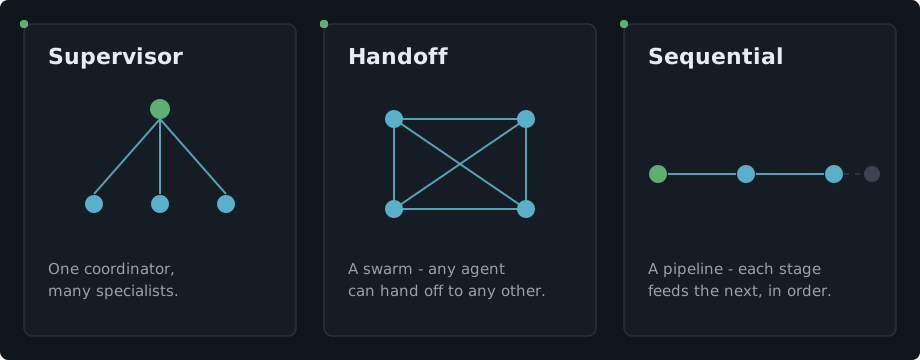
- Supervisor - one coordinator, many specialists. An orchestrator delegating to workers.
- Handoff - a swarm. Any agent can pick up work from, or hand it off to, any other.
- Sequential - a pipeline. Each stage hands finished work to the next, in order.
What you stop doing
None of the pain points above are agent intelligence - they’re infrastructure every team re-solves on the way to production. Kynomesh takes each one off the table:
| Before | With Kynomesh |
|---|---|
| Peer addresses hard-coded or hand-maintained across config | Peers found by name, automatically, from the declared pattern |
| Autoscaling tuned to a signal that doesn’t fit the workload | Capacity learned from real traffic, not a borrowed CPU metric |
| Deploys that hope nothing is mid-conversation | Rollouts that let live exchanges finish before a pod goes away |
| Every language reinventing its own A2A plumbing | A2A plumbing owned by the platform, not the agent |
| No shared ceiling on how hard one agent gets hit | Built-in limits that protect an agent and what it depends on |
It all stays Kubernetes-native - the same kubectl, GitOps, and RBAC your platform team already runs, no second control plane to operate alongside it - and language-agnostic, so a team can mix a Go coordinator with a Python researcher without either one knowing the other exists.
Infrastructure, not a framework you’re locked into
Kynomesh deliberately stays out of agent logic. It’s built on A2A, an open, emerging standard for agent-to-agent communication, and its SDKs are thin wrappers around the official A2A SDKs, not a replacement for them. Nothing about adopting Kynomesh asks a team to abandon the agent framework they’ve already built on - LangGraph, Google ADK, CrewAI, or a hand-rolled agent loop all keep working underneath.
That’s a deliberate bet: the value Kynomesh adds is at the infrastructure layer - placement, discovery, scaling, rollout - not at the agent-logic layer, where teams have the most reason to want control and the least patience for lock-in.
Get involved
Multi-agent systems are leaving the process and heading for the cluster. The question isn’t whether your team builds the discovery, scaling, and rollout layer underneath them - it’s whether you build it once, yourselves, per project, or declare it.
Kynomesh is Apache 2.0 licensed.